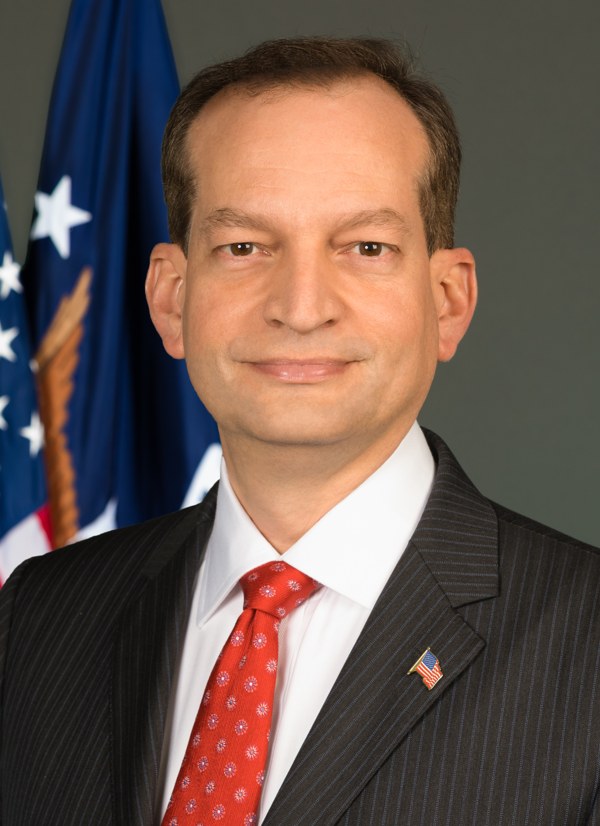
 Alexander Acosta, official portrait as Secretary of Labor. US Department of Labor via Wikimedia Commons, CC BY 2.0. | |
| Office | U.S. Attorney, Southern District of Florida; interim from June 2005, sworn in October 2006, left June 20091 |
| Earlier offices | Member, National Labor Relations Board (2002); Assistant Attorney General, Civil Rights Division (August 2003 – 2005)1 |
| Later offices | Dean, Florida International University College of Law (2009); U.S. Secretary of Labor (April 2017 – July 19, 2019)1 |
| 2007 Non-Prosecution Agreement | Executed on his authority; approved by him; not signed by him23 |
| OPR conclusion | No professional misconduct; “poor judgment” in resolving the investigation through the agreement and in failing to ensure victims were notified of the state plea hearing45 |
| Departure | Resigned as Secretary of Labor July 12, 2019, effective July 1961 |
R. Alexander Acosta was United States Attorney for the Southern District of Florida when his office resolved its 2006–2008 criminal investigation of Jeffrey Epstein through a non-prosecution agreement rather than a federal indictment.78 The agreement was executed “on the authority of R. Alexander Acosta, United States Attorney for the Southern District of Florida,” and the Justice Department’s Office of Professional Responsibility (OPR) found that although Acosta did not sign it, he participated in its drafting, approved it with knowledge of its terms, and accepted responsibility for it.23 OPR concluded that none of the five subject attorneys committed professional misconduct, but that Acosta’s decision to resolve the federal investigation through the agreement “constitutes poor judgment,” and that he exercised poor judgment a second time when he left the decision whether to notify victims of the state plea hearing to the state prosecutor.45 Acosta was Secretary of Labor when Epstein was arrested in the Southern District of New York on July 6, 2019; he held a press conference defending his handling of the case on July 10 and submitted his resignation on July 12.6 Acosta’s own explanations to OPR on both points are set out below.910
Career before the Epstein case
Acosta was appointed interim U.S. Attorney for the Southern District of Florida in June 2005, at age 36; President George W. Bush formally nominated him in June 2006 and he was sworn in as U.S. Attorney in October 2006.1 After law school he served a federal appellate clerkship, spent eighteen months as an associate at Kirkland & Ellis in Washington, D.C., worked about four years as a policy fellow and law school lecturer, and served nearly two years as a Deputy Assistant Attorney General in the Justice Department’s Civil Rights Division.1 He was appointed to the National Labor Relations Board in 2002 and, in 2003, Assistant Attorney General in charge of the Civil Rights Division, where he served from August 2003 until his appointment as interim U.S. Attorney and where he oversaw, among other matters, the prosecution of human trafficking and child sex-trafficking cases.1 As U.S. Attorney his office was in the Miami headquarters.1
The federal investigation
The Palm Beach Police Department began investigating Epstein in 2005 after a complaint that he had paid a minor for a massage.7 A Palm Beach County grand jury indicted Epstein on July 19, 2006 for felony solicitation of prostitution; dissatisfied with the state’s handling of the case, the police chief and the lead detective referred the matter to the FBI in West Palm Beach.7 The FBI brought it to an Assistant U.S. Attorney, who opened a file with her supervisor’s approval and with Acosta’s knowledge, and who in May 2007 submitted a draft 60-count indictment and a prosecution memorandum to her supervisors.7 At a July 31, 2007 meeting with Epstein’s attorneys the office offered to end its investigation if Epstein pleaded guilty to state charges, served a minimum of two years’ incarceration, registered as a sexual offender, and agreed to a mechanism through which victims could obtain damages.7 In a November 30, 2007 letter narrating the negotiations, Acosta wrote that Epstein’s counsel remained dissatisfied and that a further meeting was arranged for September 7, 2007 to allow additional attorneys to attend, at which he, other prosecutors and FBI agents met with Epstein’s counsel, and that “the unanimous opinion of all of the attorneys present was in favor of prosecution.”11 At that meeting counsel for Epstein proposed that he instead serve a sentence of home confinement at his Palm Beach house, with private security officers serving as “wardens,” on the ground that “as a wealthy white man, your client may be the subject of violence or extortion while in prison,” and urged that Epstein’s “extensive charitable giving should be considered in our prosecution decision.”11 Acosta wrote that he “summarily rejected these proposals,” and that of four other prosecutors present, representing a combined experience of more than fifty years, “[n]ever had any of them heard, or heard of, an attorney making a similar argument, and especially not in a child exploitation case.”11
The 2007 non-prosecution agreement
Negotiations over the following weeks produced the non-prosecution agreement, signed on September 24, 2007.712 Shortly after midnight that day Acosta sent AUSA A. Marie Villafaña “[s]mall edits” to the version she had called final, substituting language that required Epstein alone to make a binding sentencing recommendation to the state court rather than binding the State Attorney or the state judge; Villafaña circulated the revised text that morning and the signed agreement was returned that afternoon.12 The recitals provide that “on the authority of R. Alexander Acosta, United States Attorney for the Southern District of Florida, prosecution in this District for these offenses shall be deferred in favor of prosecution by the State of Florida.”2
The agreement required Epstein to plead guilty in state court to the pending indictment charging one count of solicitation of prostitution under Fla. Stat. § 796.07 and to an information charging a registrable offense, described in the agreement as “the solicitation of minors to engage in prostitution, in violation of Florida Statutes Section 796.03” and identified by OPR as procurement of minors to engage in prostitution under the same statute.28 It required him to make a binding recommendation of “a thirty (30) month sentence”: consecutive terms of twelve and six months in county jail followed by twelve months of community control.28 In exchange the United States agreed to forgo federal prosecution in the district of Epstein, four people named as potential co-conspirators, and “any potential co-conspirators,” and provided a mechanism through which identified victims could recover damages under 18 U.S.C. § 2255.28 Victims were not informed of or consulted about the agreement before it was signed.8
Signatures
The copy of the agreement filed in Epstein’s 2019 bail proceedings carries three versions of the final page, signed separately by Epstein, by Gerald Lefcourt and by Lilly Ann Sanchez, each dated 9/24/07; no government representative signed any of the three: the signature block is headed with Acosta’s name and title, beneath which a line marked “By:” carries the printed name of the line prosecutor, A. Marie Villafaña, and that line is blank on all three copies.13 OPR records that the final agreement as signed by Epstein, his attorneys Lefcourt and Sanchez, and Villafaña contained the operative terms, and that Villafaña told defense counsel she would sign and return a copy when she received the originals.1412 OPR states that Acosta “did not sign the NPA.”3
The co-conspirators clause
The clause on page 5 of 7 names Sarah Kellen, Adriana Ross, Lesley Groff and Nadia Marcinkova and reads, in the page image:2
In consideration of Epstein’s agreement to plead guilty and to provide compensation in the manner described above, if Epstein successfully fulfills all of the terms and conditions of this agreement, the United States also agrees that it will not institute any criminal charges against any potential co-conspirators of Epstein, including but not limited to Sarah Kellen, Adriana Ross, Lesley Groff, or Nadia Marcinkova.2
OPR found that “[i]mportant provisions, such as promising not to prosecute all ‘potential co-conspirators,’ were added with little discussion or consideration by the prosecutors.”15 Acosta told OPR that he did not recall the provision or any discussion of it, and speculated that if he read it he likely assumed the line prosecutor and her supervisor had “thought this through” and “addressed it for a reason.”16 First Assistant U.S. Attorney Jeffrey Sloman told OPR he had understood the provision to protect the people named in it, and that it never occurred to him that it was directed at any of the high-profile figures later linked to Epstein.16 The West Palm Beach manager called the provision “highly unusual” and said he had “no clue” why the office agreed to it.16
Confidentiality
Term 13 provides: “The parties anticipate that this agreement will not be made part of any public record.”2 When defense counsel asked the office to “do whatever you can to keep this from becoming public,” Acosta replied that the agreement “already binds us not to make public except as required by law under [the Freedom of Information Act],” and asked, “[W]hat more does he want?”12 The agreement was filed under seal with the state court; after victims and news media sued in Florida courts for its release, a state judge ordered it made public in September 2009.817
After signing
Epstein did not plead guilty for another nine months, during which his attorneys sought to change the agreement’s terms and to have senior Justice Department officials set it aside.8 The first dispute concerned selection of an attorney representative for the victims, and led Sloman and defense counsel Jay Lefkowitz to negotiate an addendum.18 On October 29, 2007 Epstein and his attorneys Lefcourt and Sanchez signed the addendum; Villafaña’s name was printed as the office’s representative, but at her request Sloman signed it for her on behalf of the office.18 Acosta did not sign the addendum.1819 The filed copy of the addendum, like the agreement itself, shows the government’s signature line blank; a separate affirmation page, signed by Epstein and dated 12/7/07, re-affirms “the Non-Prosecution Agreement and Addendum to same dated October 30, 2007.”1920
The October 12, 2007 breakfast meeting
Acosta and Lefkowitz met for breakfast on October 12, 2007 at a Marriott hotel in West Palm Beach, arranged by email the previous day; contemporaneous records show Acosta was already scheduled to be in West Palm Beach for a press event and a bar conference and stayed at the hotel overnight.21 In an October 23, 2007 letter Lefkowitz wrote that at the meeting Acosta had assured him the office would not intervene with the State Attorney’s Office, would not contact identified individuals, potential witnesses or potential civil claimants, and would not intervene regarding Epstein’s sentence so long as it did not violate state law.21 Two days after receiving that letter Acosta revised a draft response prepared by Sloman, adding the word “inaccurate” to describe those claims; the draft stated that “[s]uch a promise equates to the imposition of a gag order. Our Office cannot and will not agree to this,” and OPR did not find evidence that it was ever sent.21 In a December 2007 letter to Sanchez, Acosta wrote that he had “sua sponte proposed the Addendum to Mr. Lefkowitz at an October meeting in Palm Beach … in an attempt to avoid what I foresaw would likely be a litigious selection process.”21 Acosta told OPR he did not remember the meeting, and said the press account “was that I negotiated [the NPA] over breakfast,” which was inaccurate because the agreement had been signed weeks earlier.21 OPR found no evidence that the meeting “led to the NPA, which had been signed weeks earlier, or to any other significant decision that benefited Epstein.”4
Responding on November 30, 2007 to a further letter from Starr, Acosta wrote, over his own typed name: “please provide us with a definitive statement, signed by your client, of his intention to abide by each and every term of the Agreement by close of business on Tuesday, December 4, 2007,” with a plea and sentencing “no later than December 14, 2007,” warning that otherwise “we will deem the agreement to be rescinded and will proceed with the prosecution. There must be closure in this matter.”22 Epstein did not plead guilty until June 30, 2008, almost seven months after the stated deadline, and the agreement was not rescinded.8
Defense counsel continued to contact Acosta directly: on January 30, 2008 Lefkowitz emailed him a “heads up” about a civil suit announced against Epstein, and Acosta forwarded the message to a line prosecutor with the single word “Fyi.”23
Epstein pleaded guilty in state court on June 30, 2008 and was sentenced the same day to consecutive terms of twelve and six months’ incarceration followed by twelve months of community control.8 He was approved for the county sheriff’s work release program and from October 2008 spent twelve hours a day at an entity he had recently incorporated, received “gain time” for good behavior, served less than thirteen months of the eighteen-month jail term, and was released to home detention on July 22, 2009.17
Recusal and departure from the office
On December 8, 2008, while Epstein was serving his state sentence, Acosta was formally recused from all matters involving Kirkland & Ellis, the firm then representing Epstein, because he had begun discussing possible employment with it.1 Sloman thereafter became the senior official supervising the matter.1 Acosta left the office in June 2009 and became Dean of Florida International University College of Law.1
The victims’ rights litigation
A victim identified as “Jane Doe” petitioned the federal district court in the Southern District of Florida on July 7, 2008, alleging that the government violated the Crime Victims’ Rights Act by resolving the investigation without consulting victims.8 On February 21, 2019 the court granted the petitioners partial summary judgment, ruling that the government violated the Act in failing to advise victims of its intention to enter the agreement.6 The court found that letters sent to victims after the agreement was signed, describing the investigation as ongoing, “mislead [sic] the victims to believe that federal prosecution was still a possibility,” and highlighted the inequity of the office’s failure to communicate with victims while engaging in “lengthy negotiations” with Epstein’s counsel and assuring the defense that the agreement would not be “made public or filed with the court.”6 OPR later determined that none of the subject attorneys was responsible for those letters, which were sent by an FBI administrative employee using standard form language and were not drafted or reviewed by the subjects.5 See the CVRA litigation.
The OPR investigation
OPR opened its investigation after the Miami Herald’s November 28, 2018 report, on a December 3, 2018 request from the chairman of a Senate Judiciary oversight subcommittee, and broadened it after the February 21, 2019 CVRA ruling.2425 It reviewed hundreds of thousands of records, conducted more than sixty witness interviews, and identified Acosta, three former office supervisors and the line AUSA as subjects; all five cooperated, provided written responses, were interviewed under oath, and commented on the draft report.25 The report is dated November 2020.26
Findings on the agreement
OPR concluded that none of the subjects committed professional misconduct in developing, negotiating and approving the agreement; that Acosta’s decision not to initiate a federal prosecution was within the scope of his authority; and that it found no evidence the decision “was based on corruption or other impermissible considerations, such as Epstein’s wealth, status, or associations.”4 It noted that Acosta had resisted defense efforts to return the matter to the state without conditions and had refused to eliminate the incarceration and sex-offender registration requirements.4
OPR nonetheless concluded that “Acosta’s decision to resolve the federal investigation through the NPA constitutes poor judgment.”4 In its summary: “Acosta’s application of federalism principles was too expansive, his view of the federal interest in prosecuting Epstein was too narrow, and his understanding of the state system was too imperfect to justify the decision to use the NPA.”4 Section V of the report, “Acosta Exercised Poor Judgment by Resolving the Federal Investigation Through the NPA,” finds that his application of Petite policy principles was flawed, the policy having not applied because the state case was still pending, a point Acosta acknowledged to OPR, and that the resulting agreement “was too difficult to administer, leaving Epstein free to manipulate the conditions of his sentence to his own advantage.”15 Acosta himself told OPR that the exploitation of minors was “an important federal interest.”15 Acosta’s own explanation, as OPR records it, was that absent intervention by his office the state prosecution would have become final, that it was therefore “prudent” to apply Petite policy analysis, and that “the federal responsibility” was to serve as a “back-stop [to] state authorities to ensure that there [was] no miscarriage of justice”; he said the police department would not have brought the case to the FBI had the State Attorney pursued charges requiring incarceration, and that his office could avert a “manifest injustice” by forcing the state to jail Epstein and require him to register.9 OPR called that reasoning “flawed and unduly constricted,” on the ground that the Petite policy does not require federal restraint where no state prosecution has been completed.9
Findings on victim notification
OPR concluded that Acosta exercised poor judgment a second time in that, after the agreement was signed, he “elected to defer to the State Attorney the decision whether to notify victims about the state’s plea hearing” and “failed to make certain that the state intended to and would notify victims identified through the federal investigation about the state plea hearing.”5 The report states that his decision “left victims uninformed about an important proceeding that resolved the federal investigation” and “created the misimpression that the Department intentionally sought to silence the victims.”5 Acosta told OPR that it had been his understanding at the time of the plea that victims would be made aware of the proceeding and would have an opportunity to speak, and that he expected the state would have “notified [the victims] that that was an all-encompassing plea, that the state court sentence would also mean that the federal government was not proceeding”; OPR found no evidence that he verified that understanding with his own staff or with the State Attorney, and no evidence that he acted for the purpose of excluding victims from the plea hearing.10 OPR found no evidence that the lack of consultation before the agreement was signed was for the purpose of silencing victims.45
The “intelligence asset” question
Addressing press reports, as OPR summarized them, that Epstein had been released early for cooperating in a financial investigation or had been an “intelligence asset,” OPR recorded that “Acosta told OPR that he did not have any information about Epstein cooperating in a financial investigation or relating to media reports that Epstein had been an ‘intelligence asset.’”27 Asked about his answer on the point at his 2019 press conference, “Acosta stated to OPR that ‘the answer is no,’” and was told OPR could use a classified setting to discuss intelligence information.27 OPR found no evidence that Epstein was a cooperating witness or intelligence asset, that anyone believed he was, or that he received any benefit on that basis.27
2019
After the Miami Herald report, media and congressional attention focused on Acosta as the official responsible for the agreement.6 On July 10, 2019, four days after Epstein’s arrest in the Southern District of New York, he held a televised press conference at which he said the Palm Beach State Attorney’s Office “was ready to allow Epstein to walk free with no jail time, nothing,” and argued that his office had instead obtained a resolution that jailed Epstein, required him to register as a sexual offender, and gave victims a means of obtaining damages.6 He submitted his resignation as Secretary of Labor to the President on July 12, 2019, effective July 19, explaining in a brief oral statement that continued media attention on his handling of the Epstein investigation rather than on the economy was unfair to the Labor Department.6241
The immunity clause after Epstein’s death
Ghislaine Maxwell moved to dismiss her 2020 superseding indictment in the Southern District of New York on the ground that the co-conspirators clause immunized her as a third-party beneficiary.28 Judge Alison J. Nathan denied the motion on April 16, 2021.29 The Second Circuit affirmed on September 17, 2024, holding: “We hold that Epstein’s NPA did not bar Maxwell’s prosecution by USAO-SDNY as the NPA does not bind USAO-SDNY.”30 Maxwell’s petition for a writ of certiorari, filed April 10, 2025, reproduced the agreement and excerpts of the OPR report as appendices.31
Related
- People: Marie Villafaña; Sarah Kellen; Adriana Ross; Lesley Groff; Nadia Marcinkova; Ghislaine Maxwell; Julie K. Brown.
- Cases: 2008 Non-Prosecution Agreement; Palm Beach Police investigation; CVRA litigation; SDNY 2019 indictment.
- Topics: Operation Leap Year; Federal charging decisions; Epstein’s defense team; Epstein investigations overview.
Coverage
- Julie K. Brown, “Perversion of Justice,” Miami Herald, November 28, 2018. OPR records that the paper reported Acosta had made an extraordinary agreement letting Epstein avoid federal prosecution through a state plea, that the government immunized his co-conspirators, and that the terms were concealed from victims.17
- OPR’s footnote to the resulting coverage lists Ashley Collman, “Stunning new report details Trump’s labor secretary’s role in plea deal for billionaire sex abuser,” The Business Insider, November 29, 2018; Cynthia McFadden, “New Focus on Trump Labor Secretary’s role in unusual plea deal for billionaire accused of sexual abuse,” NBC Nightly News, November 29, 2018; Anita Kumar, “Trump labor secretary out of running for attorney general after Miami Herald report,” McClatchy Washington Bureau, November 29, 2018; and Emily Peck, “How Trump’s Labor Secretary Covered For A Millionaire Sex Abuser,” Huffington Post, November 29, 2018.6
Footnotes
-
OPR Report, full text filed as Government Exhibit 3, Document 204-3 in United States v. Maxwell, No. 1:20-cr-00330-PAE, April 16, 2021, narrative pp. 4–5. https://epstein-data.com/DOJ-OGR-00003177 ↩ ↩2 ↩3 ↩4 ↩5 ↩6 ↩7 ↩8 ↩9 ↩10 ↩11 ↩12
-
Non-Prosecution Agreement, September 2007, filed as Exhibit 1 to Document 6-1 in United States v. Epstein, No. 1:19-cr-00490-RMB (S.D.N.Y.), July 11, 2019. Authority clause at p. 2 of 7; charges and sentence at p. 3 of 7, terms 1 and 2; co-conspirators clause and term 13 at p. 5 of 7; quoted passages read from the page image. https://epstein-data.com/DOJ-OGR-00000290 ↩ ↩2 ↩3 ↩4 ↩5 ↩6 ↩7 ↩8 ↩9
-
OPR Executive Summary, p. ix, read from the page image. https://epstein-data.com/DOJ-OGR-00002533 ↩ ↩2 ↩3
-
OPR Executive Summary, p. x, read from the page image. https://epstein-data.com/DOJ-OGR-00002533 ↩ ↩2 ↩3 ↩4 ↩5 ↩6 ↩7 ↩8
-
OPR Executive Summary, p. xi, read from the page image. https://epstein-data.com/DOJ-OGR-00002533 ↩ ↩2 ↩3 ↩4 ↩5 ↩6
-
OPR Executive Summary, p. iv and n.4, read from the page image. https://epstein-data.com/DOJ-OGR-00002533 ↩ ↩2 ↩3 ↩4 ↩5 ↩6 ↩7 ↩8
-
OPR Executive Summary, p. i, read from the page image. https://epstein-data.com/DOJ-OGR-00002533 ↩ ↩2 ↩3 ↩4 ↩5 ↩6
-
OPR Executive Summary, p. ii, read from the page image. https://epstein-data.com/DOJ-OGR-00002533 ↩ ↩2 ↩3 ↩4 ↩5 ↩6 ↩7 ↩8 ↩9 ↩10
-
OPR Report, narrative p. 172. https://epstein-data.com/DOJ-OGR-00003177 ↩ ↩2 ↩3
-
OPR Report, narrative p. 270. https://epstein-data.com/DOJ-OGR-00003177 ↩ ↩2
-
Letter, R. Alexander Acosta, United States Attorney, to Kenneth W. Starr, Esq., November 30, 2007, p. 3, narrating the September 7, 2007 meeting; quotations read from the page image. https://epstein-data.com/EFTA01659896 p.3. ↩ ↩2 ↩3
-
OPR Report, narrative pp. 84–85, section VII, “September 24, 2007: Acosta Makes Final Edits, and the NPA Is Signed.” https://epstein-data.com/DOJ-OGR-00003177 ↩ ↩2 ↩3 ↩4
-
Non-Prosecution Agreement, three versions of the signature page (p. 7 of 7) at pp. 8, 9 and 10 of the filed exhibit, each dated 9/24/07 and read from the page image. https://epstein-data.com/DOJ-OGR-00000290 ↩
-
OPR Report, narrative p. 85. https://epstein-data.com/DOJ-OGR-00003177 ↩
-
OPR Report, narrative pp. 169–171, section V. https://epstein-data.com/DOJ-OGR-00003177 ↩ ↩2 ↩3
-
OPR Report, narrative p. 81. https://epstein-data.com/DOJ-OGR-00003177 ↩ ↩2 ↩3
-
OPR Executive Summary, p. iii, read from the page image. https://epstein-data.com/DOJ-OGR-00002533 ↩ ↩2 ↩3
-
OPR Report, narrative p. 93. https://epstein-data.com/DOJ-OGR-00003177 ↩ ↩2 ↩3
-
Addendum to the Non-Prosecution Agreement, signature pages at pp. 12, 13 and 14 of the filed exhibit, dated 10/29/07 and read from the page image. https://epstein-data.com/DOJ-OGR-00000290 ↩ ↩2
-
Affirmation of Jeffrey E. Epstein, p. 15 of the filed exhibit, signature dated 12/7/07 and transmitted by fax the same day; read from the page image. https://epstein-data.com/DOJ-OGR-00000290 ↩
-
OPR Report, narrative pp. 89–90, section VIII.B, “October 12, 2007: Acosta and Defense Attorney Lefkowitz Meet for Breakfast.” https://epstein-data.com/DOJ-OGR-00003177 ↩ ↩2 ↩3 ↩4 ↩5
-
Letter, R. Alexander Acosta, United States Attorney, to Kenneth W. Starr, Esq., November 30, 2007, pp. 5–6, quotations and signature read from the page image. https://epstein-data.com/EFTA01659896 pp.5–6. ↩
-
Email, Jay Lefkowitz to “Acosta, Alex (USAFLS),” January 30, 2008, 13:07, forwarded by Acosta the same day at 1:20 p.m.; the reply and the names of the victim and the recipient prosecutor are redacted on the page image. https://epstein-data.com/EFTA00013721 ↩
-
OPR Executive Summary, p. v, read from the page image. https://epstein-data.com/DOJ-OGR-00002533 ↩ ↩2
-
OPR Executive Summary, p. vi, read from the page image. https://epstein-data.com/DOJ-OGR-00002533 ↩ ↩2
-
U.S. Department of Justice, Office of Professional Responsibility, Investigation into the U.S. Attorney’s Office for the Southern District of Florida’s Resolution of Its 2006-2008 Federal Criminal Investigation of Jeffrey Epstein and Its Interactions with Victims during the Investigation, Executive Summary of Report, November 2020, filed as Exhibit D to Document 138-4 in United States v. Maxwell, No. 1:20-cr-00330-AJN, February 4, 2021; cover page, read from the page image. https://epstein-data.com/DOJ-OGR-00002533 ↩
-
OPR Report, narrative p. 169 and n.244. https://epstein-data.com/DOJ-OGR-00003177 ↩ ↩2 ↩3
-
Memorandum of Ghislaine Maxwell in Support of Motion to Dismiss Superseding Indictment for Breach of Non-Prosecution Agreement, Document 142 in No. 1:20-cr-00330-AJN, filed February 4, 2021. https://epstein-data.com/DOJ-OGR-00002573 ↩
-
Opinion and Order, United States v. Maxwell, No. 20-cr-330 (AJN) (S.D.N.Y. April 16, 2021), Alison J. Nathan, District Judge, reproduced as Appendix D to Maxwell’s petition for a writ of certiorari at 52a. https://epstein-data.com/DOJ-OGR-00000034 ↩
-
United States v. Maxwell, No. 22-1426-cr, Document 109-1, decided September 17, 2024 (2d Cir.), opinion pp. 4 and 9, read from the page image. https://epstein-data.com/DOJ-OGR-00000002 ↩
-
Petition for Writ of Certiorari, Maxwell v. United States, No. 24-, filed April 10, 2025; Appendix B reproduces the Non-Prosecution Agreement and Appendix F excerpts of the OPR Report. https://epstein-data.com/DOJ-OGR-00000034 ↩